The Safe Space Trap: Is Your Team Cultivating Psychological Safety or Just Avoiding Conflict?
We explored the critical operational boundary between a genuinely inclusive workplace and a conflict-avoidant, accountability-free zone.
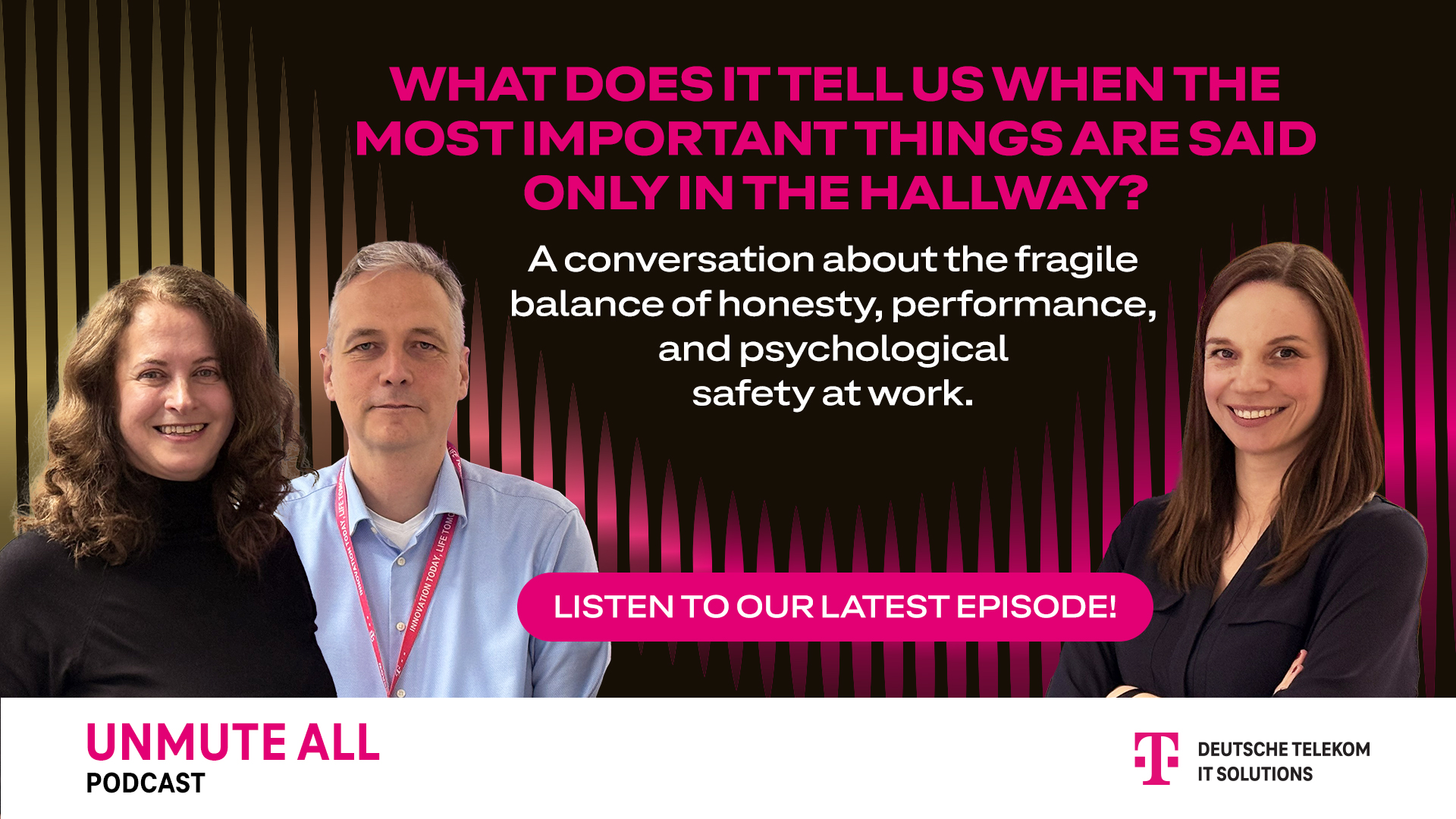
In this special episode of Unmute All podcast, host Melinda Korpa sits down with Hajnalka Holecz workplace psychologist and Péter Civin. Drawing from over twenty years of leadership experience, they explore what happens inside teams when people choose to speak up instead of staying silent, and how organizations can cultivate genuine psychological safety instead of settled compliance in the innovation-driven IT-sector.
The “Safe Space” Trap: Performance vs. Comfort
Many organizations claim to value psychological safety, but in practice, workers often find themselves victims of finger-pointing or harsh feedback when highlighting a flawed process. The experts clarify that true psychological safety is frequently misunderstood and misapplied:
Lifting the Brakes, Not Fueling: Psychological safety simply removes fear and takes the brakes off the organization, but it does not provide the fuel. Performance metrics, expectations, and KPIs belong to an entirely different set.
A Performance Enabler, Not a Shelter: It is not a “safe space” or a shelter designed for healing or covering up underperformance. Instead, it means providing all the necessary conditions for employees to perform at their full strength and capability.
Managing Errors and the Power of “I Don’t Know”
When errors occur, business environments require an active, structured approach rather than sweeping problems under the rug. Péter outlines a simple three-step protocol for dealing with workplace mistakes:
Acknowledge the mistake together: If a mistake isn’t acknowledged, the team cannot begin to fix it.
Manage the damage immediately: Mop up the spilled water before spending hours analyzing why the tap was left open.
Prevent recurrence: Put measures in place and ensure the team does everything possible so the same error does not happen again.
Similarly, there is immense strength when a leader openly admits, “I don’t know”. It shatters destructive hubris, honors the intelligence of the collective team, and invites everyone to find a solution together.
The 4 Stages of Psychological Safety
The discussion highlights Timothy Clark’s four-step framework, illustrating how trust and safety are incrementally built within a team culture:
- Inclusion Safety: The foundational level where the group accepts everyone unconditionally, regardless of individual differences.
- Learner Safety: Acknowledging that learning naturally involves making mistakes. The environment permits mistakes as long as there is an active effort to learn and grow.
- Contributor Safety: Transitioning from an apprentice to a master, where a full team member autonomously takes responsibility for the project and actively contributes ideas.
- Challenger Safety: The highest level where employees feel safe to oppose or question their leader’s decisions or organizational structures without fearing negative consequences. This serves as a true test of structural resilience for both the leader and the team.
Trusting the Process: Structural Feedback
Giving and receiving feedback can be incredibly difficult because it instantly triggers internal defenses, making people feel defensive, textually attacked, or undervalued. When a team is still developing its psychological safety, organizations should rely on structured processes rather than personal compliance:
Standardized Check-ins: Remove the vulnerability of ad-hoc feedback by building it directly into regular retrospectives or standups.
The Devil’s Advocate: Assign a specific team member or rotate the role to actively challenge ideas during critical situations. This ensures that critiques are viewed as a mandatory part of the process rather than a personal insult.
The takeaway?
Psychological safety is not a permanent state; it is a continuous learning process. When organizations move from managing just “more hands” to collaborating with “more brains,” teams do not just become faster they become significantly smarter.
Recommended Books and Podcasts of the topic
Books:
- The Fearless Organization: Creating Psychological Safety in the Workplace for Learning, Innovation, and Growth by Amy C. Edmondson
- The 4 Stages of Psychological Safety: Defining the Path to Inclusion and Innovation by Timothy R. Clark
- How to Heal a Workplace by Mark B. Banschick
- Trust and Inspire: How Truly Great Leaders Unleash Greatness in Others by Stephen M. R. Covey
Podcasts:
- Finding Mastery
- The Happiness Lab
- WorkLife with Adam Grant
Listen to the full episode here (in Hungarian): https://www.deutschetelekomitsolutions.hu/podcast/mirol-arulkodik-ha-csak-a-folyoson-hangzanak-el-a-fontos-mondatok/